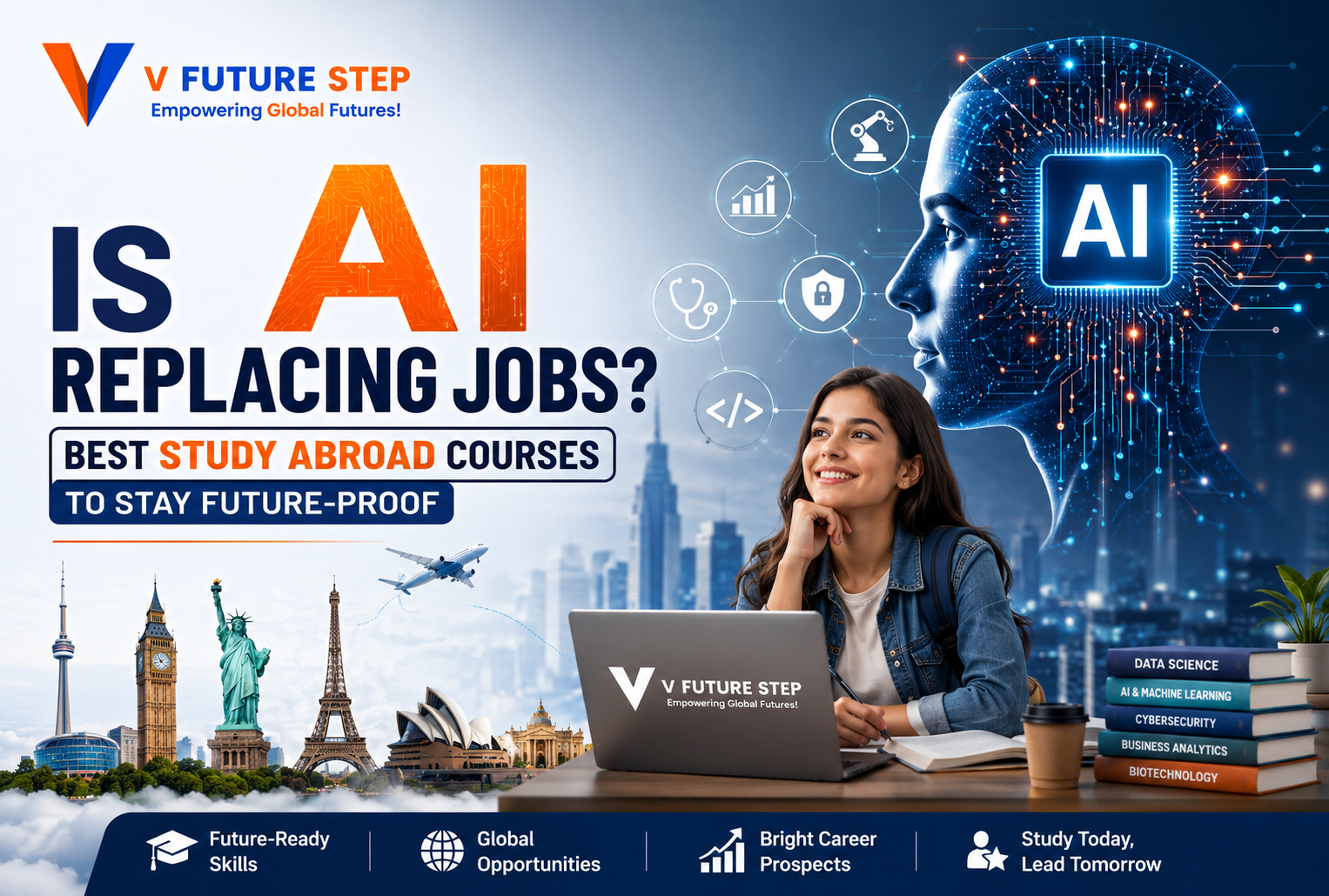
Artificial Intelligence is transforming the way people work, communicate, create, and solve problems. From automated customer service and data analysis to robotics and intelligent software, AI is becoming part of almost every major industry. This has led many students to ask an important question: Is AI replacing jobs?
The reality is more balanced. AI can automate certain repetitive tasks, but it is also creating new career opportunities and changing the skills employers value. Professionals who understand technology while also offering creativity, critical thinking, communication, and decision-making skills can remain valuable in an AI-driven workplace.
For students planning their future, choosing the right degree has therefore become increasingly important. Instead of searching for a profession that will never be affected by technology, students should focus on developing skills that allow them to work with AI.
This is where AI-Proof Study Abroad Courses can become valuable. These programs can help students build technical knowledge, practical experience, problem-solving abilities, and industry-relevant skills that can remain useful as technology continues to evolve.
Is AI Replacing Jobs or Changing Them?
AI is particularly effective at completing repetitive, predictable, and data-heavy tasks. However, most professional roles involve much more than individual tasks. They often require communication, creativity, teamwork, judgement, leadership, and an understanding of real-world situations.
For example, AI can help a software developer generate code, but the developer still needs to understand the client’s requirements, design the system, test the application, identify errors, and make technical decisions.
Similarly, AI can help healthcare professionals organize information or identify patterns, but patient care requires empathy, communication, professional responsibility, and human judgement.
This means students should not only ask, “Which jobs will AI not replace?” A better question is, “Which careers will allow me to use AI while contributing skills that technology cannot easily provide?”
What Makes a Course Future-Ready?
No degree can guarantee that a particular career will remain unchanged forever. Technology will continue to evolve, and job responsibilities will change along with it.
However, some fields offer students opportunities to combine technical expertise with creativity, human interaction, specialized knowledge, and complex decision-making.
The best AI-Proof Study Abroad Courses can help students develop:
- Technical knowledge
- Analytical thinking
- Problem-solving abilities
- Creativity
- Communication skills
- Digital literacy
- Adaptability
- Industry experience
- Critical thinking
Students should also learn how to use AI tools responsibly. Knowing how to work alongside new technology can become a valuable advantage in the workplace.
Artificial Intelligence and Machine Learning
Artificial Intelligence and Machine Learning are among the most obvious choices for students interested in the technology shaping the future.
Professionals in this field do not simply use AI applications. They learn how intelligent systems are designed, trained, tested, improved, and applied to real-world problems.
AI is being used across industries such as healthcare, finance, manufacturing, transportation, education, retail, and technology.
Skills Students Can Develop
AI-focused programs may include:
- Machine Learning
- Deep Learning
- Python
- Neural Networks
- Natural Language Processing
- Computer Vision
- Robotics
- AI Ethics
Students who want to study abroad in this field should look for programs that combine theoretical learning with practical projects and industry applications.
Computer Science and Software Engineering
Computer Science remains a strong foundation for the digital economy. Although AI can automate some coding activities, businesses still require professionals who understand software architecture, databases, cloud systems, cybersecurity, applications, and complex technical requirements.
Rather than learning only basic programming, students can build broader computing knowledge and understand how AI can improve software development.
Career Areas to Explore
Computer Science graduates can consider:
- Software Engineering
- Cloud Computing
- DevOps
- Mobile Application Development
- Systems Architecture
- AI Engineering
- Database Management
- Distributed Systems
Students planning to study in Canada can explore programs that combine Computer Science with AI, cloud computing, cybersecurity, or data analytics.
Data Science and Business Analytics
Data has become one of the most important resources for modern organizations. Companies need professionals who can collect, organize, analyze, visualize, and interpret information to support better decisions.
This makes Data Science and Business Analytics attractive options for students who enjoy mathematics, statistics, technology, and problem-solving.
What Students Can Learn
Programs may cover:
- Statistics
- Python
- Data Visualization
- Machine Learning
- Database Management
- Predictive Analytics
- Business Intelligence
AI can process large amounts of information quickly, but organizations still need people who understand business objectives and can turn data into meaningful strategies.
Cybersecurity
As businesses increasingly depend on digital systems, protecting information and infrastructure has become essential. AI can help cybersecurity teams detect unusual patterns and potential threats, but professionals are still needed to understand risks and create effective security strategies.
Cybersecurity is therefore another promising option for students looking for AI-Proof Study Abroad Courses.
Popular Cybersecurity Areas
Students can explore:
- Network Security
- Cloud Security
- Information Security
- Digital Forensics
- Security Management
- Cyber Risk
- Ethical Security Testing
This field can be particularly suitable for students who enjoy technology, investigation, logical reasoning, and problem-solving.
Healthcare and Health Technology
Healthcare is another field where technology is creating new opportunities without removing the importance of human professionals.
AI can assist with research, medical information, administration, and certain analytical processes. However, healthcare still depends heavily on communication, empathy, ethical judgement, and direct interaction with patients.
Courses to Consider
Students interested in this sector can explore:
- Healthcare Management
- Nursing
- Public Health
- Health Informatics
- Biotechnology
- Biomedical Science
- Medical Technology
Students who study in Canada can consider healthcare and technology programs that combine professional knowledge with modern digital skills.
Engineering, Robotics and Automation
Engineering combines science, mathematics, technology, and real-world problem-solving. AI can support engineers with simulations, calculations, design, and analysis, but complex physical projects still require human expertise.
Robotics is especially relevant because it combines engineering, programming, electronics, automation, and AI.
Popular Engineering Fields
Students can consider:
- Mechanical Engineering
- Electrical Engineering
- Computer Engineering
- Robotics
- Mechatronics
- Civil Engineering
- Renewable Energy Engineering
Students who study in USA can explore engineering and technology programs that provide opportunities to develop technical and practical skills.
Biotechnology and Life Sciences
Biotechnology brings together biology, technology, and scientific research. It has applications in healthcare, pharmaceuticals, agriculture, food technology, and environmental science.
Because many roles in this field require specialized scientific knowledge, laboratory work, experimentation, and research, biotechnology can be an interesting option for students seeking future-focused careers.
Areas Students Can Explore
- Biotechnology
- Biomedical Science
- Pharmaceutical Science
- Molecular Biology
- Genetics
- Bioinformatics
- Food Technology
Students who study in Ireland can explore programs connected with biotechnology, pharmaceuticals, healthcare, and life sciences.
Renewable Energy and Environmental Technology
The transition toward cleaner energy is creating opportunities in engineering, environmental science, technology, and energy management.
Students interested in sustainability can explore programs related to renewable energy, environmental engineering, energy systems, and sustainable infrastructure.
Potential Areas
Students can explore:
- Solar Energy
- Wind Energy
- Energy Storage
- Smart Energy Systems
- Environmental Engineering
- Sustainable Infrastructure
- Energy Management
Students who study in Europe can explore programs that combine sustainability with engineering and emerging technologies.
Business, Finance and FinTech
AI is changing business and finance, but it does not mean business careers are disappearing. Instead, organizations increasingly need professionals who understand both business strategy and technology.
Programs that combine business knowledge with digital skills can help students adapt to changing workplace requirements.
Future-Focused Business Courses
Students can consider:
- Business Analytics
- FinTech
- Finance
- Digital Marketing
- Supply Chain Management
- Product Management
- Technology Management
Students planning to study in UK can explore business programs that combine technology, innovation, entrepreneurship, and management.
Design and Human-Centred Technology
AI can generate designs, images, text, and layouts, but successful products still require an understanding of people. User Experience and Human-Computer Interaction combine technology with psychology, research, creativity, and problem-solving.
Skills Students Can Build
These programs can develop:
- UX Research
- Interaction Design
- Product Design
- User Testing
- Design Thinking
- Digital Product Development
These skills can help students contribute to technology products where understanding human behaviour remains important.
Education and Other Human-Centred Careers
Not every future-ready career needs to be highly technical. Fields such as education, counselling, social services, management, communication, and leadership depend strongly on human interaction.
AI can help professionals with research, planning, content creation, and administrative tasks, but empathy, communication, relationship-building, and professional judgement remain important.
Students who study in Australia can explore programs in education, healthcare, technology, environmental studies, engineering, and other areas while developing transferable skills that can support long-term career growth.
Study Abroad Destinations for Future-Ready Careers
Choosing the right destination is just as important as choosing the right course. Students should consider factors such as program quality, tuition fees, living costs, industry opportunities, practical learning, and their long-term career goals.
Study in Canada
Students who study in Canada can explore programs in Artificial Intelligence, Computer Science, Data Science, Cybersecurity, Engineering, Healthcare, and Business Analytics.
Canada offers a diverse education environment where students can develop technical knowledge while gaining exposure to modern industries.
Study in USA
Students who study in USA can explore a broad range of technology, engineering, biotechnology, healthcare, and business programs. The country’s large academic and technology ecosystem can provide students with opportunities to learn about innovation and emerging technologies.
Study in UK
Students who study in UK can consider programs related to computing, engineering, healthcare, business, data, and emerging technologies. Many programs emphasize independent learning, research, and practical application.
Study in Europe
Students planning to study in Europe can explore opportunities in engineering, sustainability, renewable energy, biotechnology, technology, and advanced manufacturing. Different European destinations offer different academic structures and career environments.
Study in Ireland
Students who study in Ireland can consider technology, cybersecurity, data science, business, biotechnology, and life-science programs. These fields can provide opportunities to combine specialized education with modern industry knowledge.
Study in Australia
Students who study in Australia can explore AI, Data Science, Engineering, Cybersecurity, Healthcare, Environmental Technology, and other future-focused disciplines.
Skills Students Should Develop Alongside Their Degree
A degree provides an academic foundation, but students can become more competitive by developing additional technical and interpersonal skills.
Technical Skills
Depending on their chosen field, students can consider learning:
- Data analysis
- Programming
- AI fundamentals
- Digital tools
- Cloud technologies
- Cybersecurity awareness
- Research methods
- Industry-specific software
Students do not necessarily need to become AI specialists. Even basic knowledge of modern technology can help professionals understand how AI affects their industry.
Human Skills
Technical knowledge is only one part of future employability. Students should also develop:
- Communication
- Creativity
- Critical thinking
- Leadership
- Teamwork
- Adaptability
- Problem-solving
- Time management
These abilities can help professionals handle situations where technology alone cannot provide the best solution.
How to Choose the Right Future-Ready Course
Students should avoid choosing a course only because it is described as “AI-proof.” No profession can be guaranteed to remain unchanged as technology develops.
Instead, students should select a course that matches their interests, abilities, and long-term career plans.
Factors to Consider
Before selecting a program, consider:
- Academic background
- Personal interests
- Career goals
- Course curriculum
- Practical training
- Internship opportunities
- Industry connections
- Total education costs
- Location
- Career development opportunities
- Opportunities to learn emerging technologies
Students should also research the subjects included in a course. A program with practical projects, updated technology, and opportunities for industry exposure can provide valuable experience.
Why Adaptability Matters in an AI-Driven World
Technology changes quickly, which means students may work with tools that do not even exist when they graduate. Instead of trying to learn every new technology, students should develop the ability to learn continuously.
For example, a student studying business today may need to understand AI analytics tomorrow. A software professional may need to work with new development tools. A healthcare professional may use increasingly advanced digital systems.
The ability to adapt can therefore become one of the most valuable career skills.
How Students Can Prepare During Their Studies
Students do not have to wait until graduation to become future-ready. They can begin developing relevant skills while completing their degree.
Build Practical Experience
Students can participate in:
- Internships
- Academic projects
- Hackathons
- Research projects
- Workshops
- Student competitions
- Industry events
Practical experience can help students understand how their academic knowledge applies to real-world situations.
Create a Strong Portfolio
Students in technology, design, data, and business-related fields can build a portfolio showcasing their projects and achievements.
A portfolio can include:
- Software projects
- Data analysis projects
- Research work
- Designs
- Business ideas
- Academic presentations
- Technical certifications
A strong portfolio can demonstrate practical abilities beyond academic grades.
Final Thoughts
So, Is AI Replacing Jobs? AI is certainly changing the workplace, automating some tasks, and influencing the skills employers need. However, it is also creating new career opportunities and making technology skills increasingly valuable.
Students should therefore focus on becoming professionals who can work effectively with technology rather than trying to avoid technology completely.
Choosing AI-Proof Study Abroad Courses can help students develop a combination of technical knowledge, practical experience, creativity, and problem-solving abilities. Artificial Intelligence, Computer Science, Data Science, Cybersecurity, Healthcare, Engineering, Biotechnology, Renewable Energy, FinTech, and human-centred technology are some of the areas worth exploring.
Whether you want to study abroad, study in Canada, study in USA, study in UK, study in Europe, study in Ireland, or study in Australia, your decision should be based on your interests, academic profile, budget, and career goals.
The future belongs not simply to people who know how to use AI, but to professionals who can combine technology with creativity, judgement, communication, and specialized expertise.
Frequently Asked Questions
Will AI replace all jobs?
No. AI can automate certain tasks and change job responsibilities, but many careers continue to require human judgement, creativity, communication, leadership, and specialized expertise.
Which courses are suitable for an AI-driven future?
AI, Computer Science, Data Science, Cybersecurity, Engineering, Healthcare, Biotechnology, Renewable Energy, FinTech, and Human-Computer Interaction are some areas students can consider.
Do I need to study Artificial Intelligence to stay future-ready?
No. Students from many different fields can prepare for the future by developing digital literacy, AI awareness, critical thinking, communication, and adaptability.
Should I choose a course only because AI-related jobs are growing?
Not necessarily. Career trends can change. Your interests, strengths, educational background, financial situation, and long-term goals should also influence your decision.
Is studying abroad useful for future career development?
International education can provide exposure to different teaching methods, multicultural environments, industry practices, and global perspectives. However, students should select their destination and course carefully based on their individual goals.
Why Choose V Future Step?
At V Future Step, students can explore, compare, and choose the right study abroad options according to their academic profile, career interests, budget, and future plans.
We also connect students with right-fit agencies and help simplify the international education journey. From selecting a suitable course and destination to understanding application requirements, our goal is to help students make informed decisions.
Whether your goal is to study in Canada, study in USA, study in UK, study in Europe, study in Ireland, or study in Australia, V Future Step can help you move toward an international education path that fits your future ambitions.