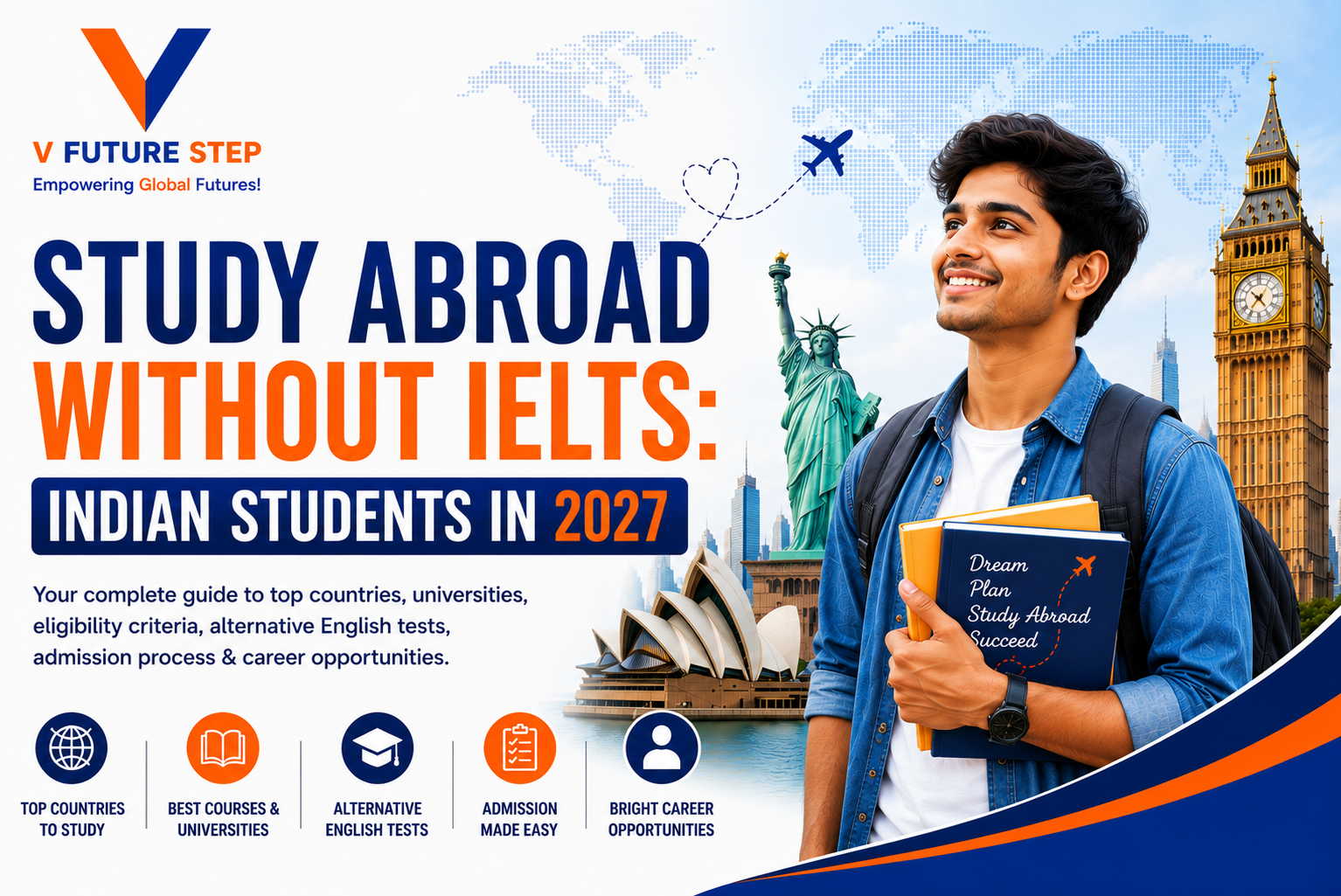
For many Indian students, the dream of studying abroad often comes with one major concern—IELTS. While this English language proficiency test is accepted by thousands of universities worldwide, not every student is comfortable taking it. Some struggle with the exam format, while others simply wish to avoid the extra expense and preparation time.
The good news is that studying abroad without IELTS in 2027 is becoming increasingly possible. Many universities now accept alternative English proficiency tests, previous academic qualifications in English, or conduct their own language assessments before granting admission.
This means students can pursue internationally recognised degrees without letting a single test become a barrier to their dreams.
In this comprehensive guide, you’ll discover the best countries that accept Indian students without IELTS, eligibility requirements, alternative language tests, admission tips, and everything you need to know before starting your global education journey.
Can You Really Study Abroad Without IELTS?
Yes, absolutely.
One of the biggest misconceptions among students is that IELTS is compulsory for every international university. While many institutions continue to accept IELTS as proof of English proficiency, several universities now offer alternative pathways for international applicants.
Many universities evaluate students based on:
- Previous education completed in English
- Medium of Instruction (MOI) certificates
- Alternative English language tests
- University-conducted interviews
- Internal English assessment programs
- Foundation or pathway courses
As international education becomes more flexible, universities are focusing more on students’ overall academic potential rather than a single language examination.
Why Are Universities Relaxing IELTS Requirements?
Global universities are competing to attract talented international students. They understand that language ability can be demonstrated in multiple ways and not necessarily through one standardized examination.
Several institutions have therefore expanded their admission policies by accepting:
- English-medium education certificates
- TOEFL
- PTE Academic
- Duolingo English Test
- Cambridge English qualifications
- University interviews
This flexibility allows deserving students to pursue higher education without unnecessary obstacles.
Best Countries to Study Abroad Without IELTS in 2027
1. Canada
Canada continues to remain one of the most preferred destinations for Indian students.
Many Canadian universities now consider alternative proof of English proficiency if students have completed their previous education in English.
Why Choose Canada?
- Excellent education system
- High-quality universities
- Safe environment
- Work opportunities during studies
- Post-graduation work permits
- Strong immigration pathways
Many institutions also conduct internal language assessments before granting admission.
Popular courses include:
- Computer Science
- Artificial Intelligence
- Business
- Healthcare
- Engineering
- Hospitality Management
2. Australia
Australia has become increasingly flexible regarding English language requirements.
Several universities accept students who can demonstrate sufficient English proficiency through previous academic education or approved alternative tests.
Popular Courses
- Nursing
- Information Technology
- Engineering
- Data Science
- Business
- Cybersecurity
Australia remains one of the strongest destinations for students seeking excellent education combined with attractive career opportunities.
3. United Kingdom
Many UK universities have introduced flexible admission pathways for international students.
Students who studied in English-medium schools may qualify for an English language waiver depending on university policies.
Some institutions may also conduct online interviews to evaluate communication skills instead of requiring IELTS scores.
Popular undergraduate and postgraduate courses include:
- Finance
- Marketing
- Law
- Computer Science
- Artificial Intelligence
- Psychology
4. Germany
Germany has become one of Europe’s fastest-growing study destinations.
Several universities offering English-taught programs accept Medium of Instruction certificates or conduct internal evaluations before admission.
Germany is particularly attractive because of its:
- Affordable education
- World-class engineering programs
- Research opportunities
- Strong industrial partnerships
Popular programs include:
- Mechanical Engineering
- Robotics
- Automotive Engineering
- Artificial Intelligence
- Renewable Energy
- Computer Science
5. Ireland
Ireland’s growing technology sector has made it an attractive destination for Indian students.
Several universities accept alternative English proficiency evidence, especially for applicants from English-medium educational backgrounds.
Popular courses include:
- Data Analytics
- Cybersecurity
- Software Engineering
- Pharmaceutical Sciences
- Finance
- Business Analytics
6. New Zealand
New Zealand is well known for its welcoming environment and internationally recognised education system.
Many universities evaluate English proficiency using previous academic qualifications or alternative tests.
Students benefit from:
- High education quality
- Safe environment
- Practical learning
- Excellent work opportunities
- Beautiful lifestyle
7. Malaysia
Malaysia has become an affordable destination for international education.
Many universities accept Indian students without IELTS if they have completed previous education in English.
Students choosing Malaysia enjoy:
- Lower tuition fees
- Affordable living expenses
- International campuses
- Diverse student community
Alternative English Tests Accepted by Universities
Even if IELTS is not required, universities may ask students to submit another recognised English language qualification.
Some commonly accepted alternatives include:
- TOEFL
- PTE Academic
- Duolingo English Test
- Cambridge English Qualifications
- LanguageCert
Several universities also accept institutional English assessments designed specifically for international applicants.
How Can Indian Students Study Abroad Without IELTS?
If you are planning to study abroad without IELTS, the admission process is almost the same as a regular international application. The main difference lies in how you demonstrate your English language proficiency.
Most universities follow a holistic admission process and evaluate your overall academic profile rather than relying on a single language test.
Step 1: Shortlist Universities
Begin by researching universities that offer IELTS waivers or accept alternative English proficiency proofs. Carefully review their admission policies, available courses, tuition fees, scholarships, and post-study opportunities.
Step 2: Check English Language Requirements
Each university has its own admission criteria. Some may accept a Medium of Instruction certificate, while others may require an online interview or an alternative English language test.
Always verify the latest requirements before applying.
Step 3: Prepare Your Documents
Most universities will require:
- Class 10, 12 or graduation transcripts
- Valid passport
- Statement of Purpose (SOP)
- Letters of Recommendation (if applicable)
- Resume (for selected programs)
- English proficiency proof or waiver document
- Passport-size photographs
Submitting complete and accurate documentation improves your chances of receiving an admission offer.
Step 4: Apply for Admission
Submit your applications before the university deadlines. Applying early also increases your chances of receiving scholarships and preferred course availability.
Step 5: Receive Your Offer Letter
Once your application is reviewed, the university may issue:
- Unconditional Offer
- Conditional Offer
- Request for an interview
- Request for additional documents
After accepting your offer, you can proceed with tuition fee payment and begin your student visa application.
What Is a Medium of Instruction (MOI) Certificate?
One of the most common alternatives to IELTS is the Medium of Instruction (MOI) Certificate.
This document is issued by your school or college and confirms that your education was conducted entirely in English.
Many universities consider the MOI certificate as sufficient evidence of English proficiency, although acceptance varies between institutions.
It is important to remember that an MOI certificate does not automatically guarantee admission, as each university follows its own admission policies.
Can You Get a Student Visa Without IELTS?
This is one of the most frequently asked questions by students.
The answer is yes, but it depends on the destination country and whether the university has officially accepted your alternative English proficiency proof.
Visa authorities generally focus on:
- A genuine admission offer
- Financial capability
- Complete documentation
- Compliance with visa requirements
If your university has admitted you without IELTS and you meet the visa conditions, obtaining a student visa is often still possible.
Scholarships Without IELTS
Many students believe scholarships are available only to applicants with IELTS scores.
Fortunately, this is not true.
Several universities award scholarships based on:
- Academic excellence
- Leadership potential
- Extracurricular achievements
- Community service
- Financial need
Your overall student profile usually plays a much bigger role than your English language test alone.
Benefits of Studying Abroad Without IELTS
Choosing to study abroad without IELTS offers several advantages for students who meet alternative admission requirements.
Saves Time
Students can avoid spending months preparing for a language examination and focus instead on strengthening their university applications.
Reduces Expenses
Skipping IELTS preparation classes and examination fees helps reduce the overall cost of studying abroad.
More Flexible Admission Process
Universities increasingly evaluate applicants using multiple assessment methods rather than relying solely on one examination.
Greater Accessibility
Students from English-medium educational backgrounds often have an opportunity to demonstrate their language skills through alternative documentation.
Common Mistakes Students Should Avoid
Although studying abroad without IELTS is possible, students should avoid several common mistakes.
Assuming Every University Waives IELTS
Not all universities offer IELTS exemptions. Always verify the official admission requirements before applying.
Ignoring Visa Requirements
University admission and student visa requirements are separate processes. Ensure you understand both before making any decisions.
Depending Only on an MOI Certificate
Some universities accept MOI certificates, while others may still require interviews or alternative English tests.
Applying at the Last Minute
Late applications reduce scholarship opportunities and limit course availability.
Not Seeking Professional Guidance
Experienced education consultants can help identify universities that best match your academic profile and career aspirations.
Why 2027 Is a Great Year to Study Abroad
International education continues to evolve, with universities becoming more student-friendly and flexible in their admission policies.
In 2027, students can benefit from:
- Expanded course options
- Flexible English language requirements
- Growing scholarship opportunities
- Industry-focused education
- Stronger international career prospects
- Improved post-study work pathways in many destinations
Students who begin planning early can maximise their chances of securing admission to their preferred universities while taking advantage of available scholarships and support services.
Final Thoughts
Choosing to study abroad without IELTS is no longer just an exception—it has become a practical option for many Indian students.
Countries such as Canada, Australia, the United Kingdom, Germany, Ireland, New Zealand, and Malaysia now offer flexible admission pathways that recognise English proficiency through alternative methods.
However, students should remember that admission policies vary between universities. Careful research, timely applications, and accurate documentation are essential for a successful study abroad journey.
Rather than letting one examination determine your future, explore all available options and choose the pathway that best aligns with your academic goals and career ambitions.
With proper planning and expert guidance, your dream of earning an international degree can become a reality in 2027.
Start Your Global Education Journey with V Future Step
V Future Step – Empowering Global Futures!
Planning to study abroad but unsure about IELTS requirements?
Our experienced counsellors help students identify universities that match their academic profile and guide them through every stage of the application process.
Our services include:
✅ University & course selection
✅ Country comparison and career counselling
✅ Scholarship assistance
✅ SOP & application support
✅ Student visa guidance
✅ Pre-departure assistance
Whether you’re planning to study in Canada, Australia, the UK, Germany, Ireland, New Zealand, or other leading destinations, V Future Step is here to help you achieve your global education goals with confidence.
Frequently Asked Questions (FAQs)
Can I study abroad without IELTS in 2027?
Yes. Many universities in countries such as Canada, Australia, Germany, Ireland, New Zealand, and the UK accept alternative proofs of English proficiency or provide IELTS waivers for eligible students.
Which countries accept Indian students without IELTS?
Popular destinations include Canada, Australia, Germany, Ireland, the United Kingdom, New Zealand, and Malaysia, depending on the university and program.
Is a Medium of Instruction certificate accepted?
Many universities accept a Medium of Instruction (MOI) certificate as proof that your previous education was completed in English. However, acceptance depends on each institution’s admission policy.
Will I still be eligible for scholarships without IELTS?
Yes. Many scholarships are awarded based on academic merit, leadership qualities, extracurricular achievements, and financial need rather than IELTS scores alone.
Is studying abroad without IELTS a good option?
Yes, provided you meet the university’s alternative English language requirements and satisfy all admission and visa conditions. It can save time, reduce costs, and provide access to excellent international education opportunities.