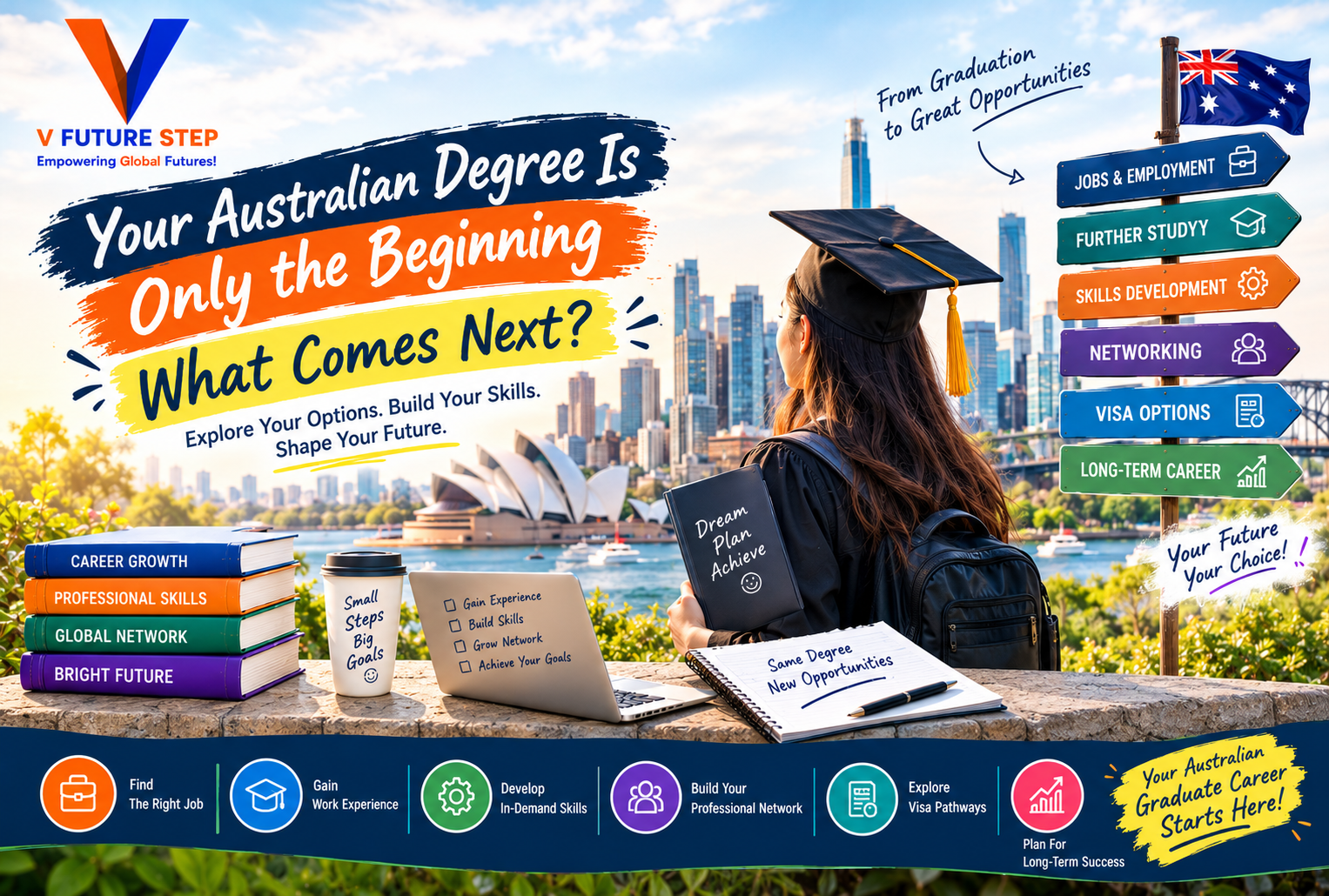
An Australian Graduate Career can begin long before graduation day. For many international students, earning a degree is a major achievement. However, the degree is only the foundation of a much longer professional journey. The choices you make during and after university can shape your skills, experience, confidence, and career direction.
Students who study in Australia often focus heavily on admission, tuition fees, accommodation, and completing their course. However, planning what comes next is equally important. Therefore, career preparation should start early rather than during the final weeks of university.
Why Your Degree Is Only the Beginning
A degree can provide valuable academic knowledge. However, employers also want to know how you can apply that knowledge.
For example, a technology graduate may understand programming concepts but still need project experience. Similarly, a business graduate may understand management theory but need stronger analytical or communication skills.
Therefore, think beyond your qualification. First, identify the skills your target industry needs. Next, find ways to develop those skills. Then, gain experience that proves what you can do.
As a result, your degree becomes more useful when it is supported by practical evidence.
Start Career Planning Before Graduation
Many students wait until their final semester to think about employment. However, this can make the transition stressful.
Instead, begin early. First, explore the types of roles connected with your course. Next, read job descriptions and identify common requirements. Then, compare those requirements with your current skills.
For example, you may notice that employers frequently ask for communication, teamwork, data analysis, programming, project experience, or specific software knowledge.
Therefore, use these requirements as a guide. Moreover, you have more time to improve when you start early.
Build Practical Experience
Academic knowledge is important. However, practical experience can show how you use that knowledge in real situations.
For example, university projects can demonstrate problem-solving. Similarly, internships can provide exposure to professional workplaces.
In addition, volunteering, competitions, research projects, and relevant part-time experiences can strengthen your profile.
Therefore, keep a record of what you accomplish. Save project reports, presentations, certificates, and useful examples of your work.
As a result, you will have stronger evidence when preparing your resume or attending interviews.
Develop Skills Employers Can Recognise
Your degree title tells employers what you studied. However, your skills show what you can contribute.
Therefore, identify the skills that matter in your chosen field. For technology students, these may include programming, databases, cloud platforms, data tools, or cybersecurity knowledge. Meanwhile, business students may benefit from analytics, communication, presentation, digital tools, and project management.
Similarly, engineering students can strengthen design, technical analysis, planning, and problem-solving skills.
Moreover, soft skills matter too. Communication, teamwork, adaptability, and time management can support many careers.
Use University Career Support
University career services can be extremely useful. However, students sometimes ignore them until graduation.
Instead, use them throughout your course. For example, career teams may provide resume reviews, interview practice, career workshops, employer events, and professional guidance.
In addition, attend networking events and employer sessions. These activities can help you understand what companies expect from graduates.
Therefore, career support should become part of your student routine, not a last-minute activity.
Create a Strong Resume
Your resume should explain more than your qualification. Therefore, show your relevant skills, experience, projects, achievements, and responsibilities.
First, highlight experiences connected to the job. Next, describe what you actually did. Then, mention the result or value of your contribution when possible.
For example, instead of saying “worked on a university project,” explain the project goal, your role, the tools you used, and the outcome.
As a result, the employer gets a clearer picture of your abilities.
Build a Professional Portfolio
A portfolio can support your resume, especially for practical careers.
For example, software students can show applications or websites. Data students can present suitable analytical projects. Designers can showcase selected creative work. Similarly, business students can present relevant research or strategy projects.
However, keep your portfolio focused. Do not include everything simply to make it longer.
Instead, choose a few strong examples that demonstrate your best skills.
Therefore, a well-organised portfolio can make your experience easier to evaluate.
Improve Your Communication Skills
Technical knowledge is valuable. However, communication can determine how effectively you use that knowledge.
For example, you may need to explain a project during an interview. Similarly, you may need to present an idea to a team or communicate with a client.
Therefore, practise speaking clearly and confidently. In addition, improve professional writing, emails, presentations, and interview responses.
As a result, stronger communication can increase your confidence in professional situations.
Start Networking Early
Networking does not have to feel complicated. Instead, think of it as building professional relationships.
First, connect with classmates and alumni. Next, attend career fairs, workshops, industry events, and professional sessions.
For example, an alumnus may explain how they entered a particular field. Similarly, an industry professional may share useful information about the skills employers value.
Moreover, maintain these relationships respectfully over time.
Therefore, networking should be about learning and building connections, not simply asking for a job.
Explore Internship Opportunities
Internships can provide valuable professional exposure. However, relevance matters more than simply having an internship.
Therefore, look for opportunities connected with your intended career. For example, technology students can seek technical roles, while business students can explore analytics, marketing, finance, or operations.
In addition, reflect on what you learned. Identify the tools you used, the problems you solved, and the responsibilities you handled.
As a result, your internship can become strong evidence of your professional growth.
Understand Your Career Options
After graduation, you may have several possible routes. Therefore, avoid assuming that everyone should follow the same path.
Some graduates move directly into employment. Others continue with further education. Meanwhile, some gain experience first and specialise later.
However, your next step should have a clear purpose.
For example, further study may help you enter a specialised field. Similarly, an entry-level role can help you gain important industry experience.
Therefore, choose the option that supports your long-term direction.
Learn How to Search for Jobs
A strong job search requires consistency. However, applying randomly can waste time.
First, identify suitable roles. Next, research employers. Then, tailor your resume and application to each position.
For example, emphasise analytical skills for a data role. Similarly, highlight technical projects for a software position.
Moreover, keep track of your applications and responses.
As a result, you can identify which strategies work best and improve your approach.
Do Not Expect Your First Job to Be Perfect
Your first job may not be your dream position. However, it can still be a valuable starting point.
For example, an entry-level role can help you understand workplace expectations. Similarly, it can provide experience that helps you qualify for future positions.
Therefore, focus on progression rather than perfection.
Over time, your responsibilities, skills, and professional network can grow.
Think About Continuous Learning
Graduation does not mean learning stops. Instead, it begins a new phase of professional development.
Therefore, follow changes in your industry. Next, identify useful skills. Then, find practical ways to develop them.
For example, you may take a short course, complete a relevant project, or earn a targeted certification.
However, avoid collecting certificates without a reason. Instead, choose learning that supports your career direction.
Make the Most of Your Australian Education
Students who study in Australia invest significant time and money in their education. Therefore, they should think carefully about how to turn that investment into professional value.
Your degree provides knowledge. Your projects demonstrate ability. Your internships provide experience. Your network creates connections.
Moreover, continuous learning helps you remain adaptable.
Therefore, start building your career profile while you are still at university.
Build Your Australian Graduate Career Strategy
A successful Australian Graduate Career strategy should bring everything together.
First, identify your target field. Next, build relevant skills. Then, gain practical experience. After that, improve your resume and portfolio.
At the same time, use career services and develop professional relationships.
As a result, graduation becomes a transition into your career instead of the moment when career planning begins.
What Comes After Graduation?
The period after graduation can feel exciting and uncertain. However, you do not need to have every answer immediately.
Instead, create a practical plan. First, decide what kind of role you want. Next, identify the skills you need. Then, build experience and apply for suitable positions.
For graduates who study in Australia, this approach can create a smoother transition from university life to professional life.
Focus on Relevant Entry-Level Roles
Your first job should help you move forward. Therefore, look beyond job titles and examine the actual responsibilities.
For example, a technology graduate may find relevant experience in testing, support, development, data, or systems. Similarly, a business graduate may explore operations, analytics, marketing, finance, or project roles.
Moreover, related positions can help you discover what you enjoy.
As a result, an entry-level role can become a useful stepping stone.
Consider Further Education Carefully
Further study can be valuable. However, it should have a clear purpose.
First, identify what you want to achieve. Next, decide whether another qualification is necessary.
For example, a specialised course may help you gain a particular technical skill. Meanwhile, professional experience may be more useful when you already have the required academic foundation.
Therefore, compare the time, cost, and expected value before enrolling.
Use Professional Certifications Wisely
Certifications can strengthen a graduate profile when they match a specific career goal.
For example, technology graduates may develop skills in cloud computing, data, or other relevant areas. Similarly, business graduates may pursue targeted learning in analytics, project management, or digital tools.
However, more certificates do not automatically mean a stronger profile.
Instead, select qualifications that solve a genuine skill gap.
Improve Your Interview Preparation
Getting an interview is only one part of the process. Therefore, prepare before each interview.
First, research the employer. Next, understand the position. Then, prepare examples from your projects, internships, and university experience.
For example, think about a time when you solved a problem or worked with a team. Similarly, prepare an example that shows how you handled a deadline or learned a new skill.
Moreover, practise speaking naturally instead of memorising every word.
As a result, you can communicate your experience more confidently.
Turn University Projects Into Career Evidence
Your university assignments should not disappear after submission. Instead, consider how they can support your career.
For example, a technology project can become part of your portfolio. Similarly, a business research project can demonstrate analytical and presentation skills.
Therefore, keep your best work organised.
In addition, learn to explain the purpose, process, tools, challenges, and results of each project.
As a result, your academic experience becomes professional evidence.
Build Relationships After Graduation
Networking should continue after university. Therefore, stay connected with classmates, alumni, mentors, lecturers, and industry contacts.
For example, attend professional events or online industry sessions. Similarly, maintain relationships with people you worked with during internships.
However, networking should remain genuine.
Instead of asking for opportunities immediately, focus on learning, sharing, and maintaining professional relationships.
Stay Open to Different Locations
Your first career opportunity may not be in your preferred city. Therefore, keep your location options flexible when practical.
For example, another city may offer better opportunities in your chosen industry. Similarly, a regional role may provide valuable experience.
However, compare rent, transportation, lifestyle, and career value before moving.
Therefore, location should support your career rather than limit it.
Keep Your Financial Plan Strong
Career development also involves financial decisions. Therefore, understand your monthly expenses while searching for work or planning your next step.
First, calculate your essential costs. Next, consider your savings and expected income. Then, decide how much you can spend on further learning or relocation.
Moreover, avoid unnecessary spending during the transition period.
As a result, good financial planning can give you more flexibility.
Understand That Careers Take Time
Professional growth rarely happens overnight. Therefore, do not compare your progress with another graduate.
Some people find work quickly. Others need more time to gain experience or improve specific skills.
Instead, focus on steady progress.
For example, one application may teach you how to improve your resume. Similarly, one unsuccessful interview can show you which answers need more preparation.
Therefore, treat every experience as a learning opportunity.
Keep Improving Your Professional Skills
Your career will continue to change. Therefore, keep developing skills even after you find your first job.
First, observe what your workplace requires. Next, identify areas where you can improve. Then, practise those skills through projects or training.
In addition, stay curious about developments in your industry.
As a result, continuous learning can help you adapt to new responsibilities.
Create a Three-Year Career Direction
Instead of thinking only about your first job, consider where you want to be after a few years.
For example, an entry-level data professional may want to move into advanced analytics. Similarly, a junior engineer may aim for greater technical responsibility.
Therefore, ask yourself what experience you need next.
Then, choose current opportunities that can help you reach that point.
Keep a Backup Career Route
Not every career plan works exactly as expected. Therefore, keep one or two related options available.
For example, a graduate interested in software development may also consider testing, support, or business analysis. Similarly, a finance graduate may explore operations or analytics.
However, a backup route should still connect with your long-term strengths.
As a result, you can stay flexible without losing direction.
Understand Work and Visa Rules Separately
International graduates may also need to consider work or immigration requirements. However, career planning and visa planning should not be confused.
Rules can depend on your qualification, visa status, occupation, timing, and other personal factors. Therefore, never assume that an Australian degree automatically guarantees a particular outcome.
Instead, build your professional profile first. Then, understand which options may apply to your situation.
Avoid Common Post-Graduation Mistakes
Several mistakes can slow down your progress.
First, waiting until graduation to begin career planning can reduce your preparation time. Second, sending the same resume everywhere can make your applications less effective. Third, collecting certificates without gaining practical experience may not solve the real problem.
Similarly, depending entirely on part-time work or one career path can create unnecessary pressure.
Therefore, keep your approach balanced and realistic.
Make Your Australian Graduate Career Stronger
A strong Australian Graduate Career comes from several elements working together.
Your degree provides academic knowledge. Your projects show practical ability. Your experience demonstrates workplace readiness. Your network creates professional connections.
Moreover, continuous learning keeps your skills relevant.
Therefore, do not depend on one factor. Build your profile step by step.
Study in Australia With the Future in Mind
Students who study in Australia should think about the complete journey, not only the classroom experience.
First, choose a suitable course. Next, gain relevant experience. Then, build professional skills and connections.
At the same time, review your future options and keep your plans flexible.
As a result, your Australian education can become a strong base for long-term professional growth.
Your Degree Is a Starting Point
Your graduation certificate is important. However, it is not the end of your career story.
Instead, use it as a foundation. Continue learning. Build experience. Develop professional relationships. Improve your communication. Also, remain open to new opportunities.
For students who study in Australia, the years after graduation can become a valuable period of professional development.
Final Thoughts
The question is not simply, “What will I do after my degree?” Instead, ask, “What kind of career do I want to build, and what should I do next to move toward it?”
That change in thinking can make a major difference.
Therefore, start early. Build relevant skills. Gain practical experience. Use university career services. Network consistently. Keep learning. Finally, review your goals as your experience grows.
An Australian Graduate Career is not one fixed path. It is a journey that develops through informed choices, patience, experience, and continuous improvement.
How V Future Step Can Help
Choosing the right course is only the first step in an international education journey. Therefore, students also need to think about career direction, university options, budget, and future opportunities.
V Future Step helps students explore, compare, and choose the right study abroad options based on their academic goals, interests, and budget. In addition, V Future Step connects students with right-fit agencies and guidance for course selection, applications, documentation, and visa planning.
FAQs
What should I do after completing my Australian degree?
Start by identifying your target career, updating your resume, building practical experience, and exploring suitable roles. Then, continue improving your skills.
Is an Australian degree enough for career success?
A degree is an important foundation. However, experience, skills, communication, networking, and professional preparation also matter.
Should I continue studying after graduation?
Only when further education supports a clear goal. Otherwise, gaining relevant work experience may be more useful.
Can I change my career after graduation?
Yes. However, identify the new field, understand its requirements, and build the skills or experience you need.
Why is networking important?
Networking can help you learn about industries, understand professional expectations, and build long-term connections.
How early should I start career planning?
Start while you are still studying. Therefore, you have more time to gain experience, improve your skills, and prepare for employment.