Planning to study overseas is an exciting milestone, but the application process requires careful preparation. One of the most important aspects of a successful application is ensuring that all necessary documents are complete, accurate, and submitted on time. Missing or incorrect paperwork can delay your admission, visa processing, or even affect your chances of studying abroad.
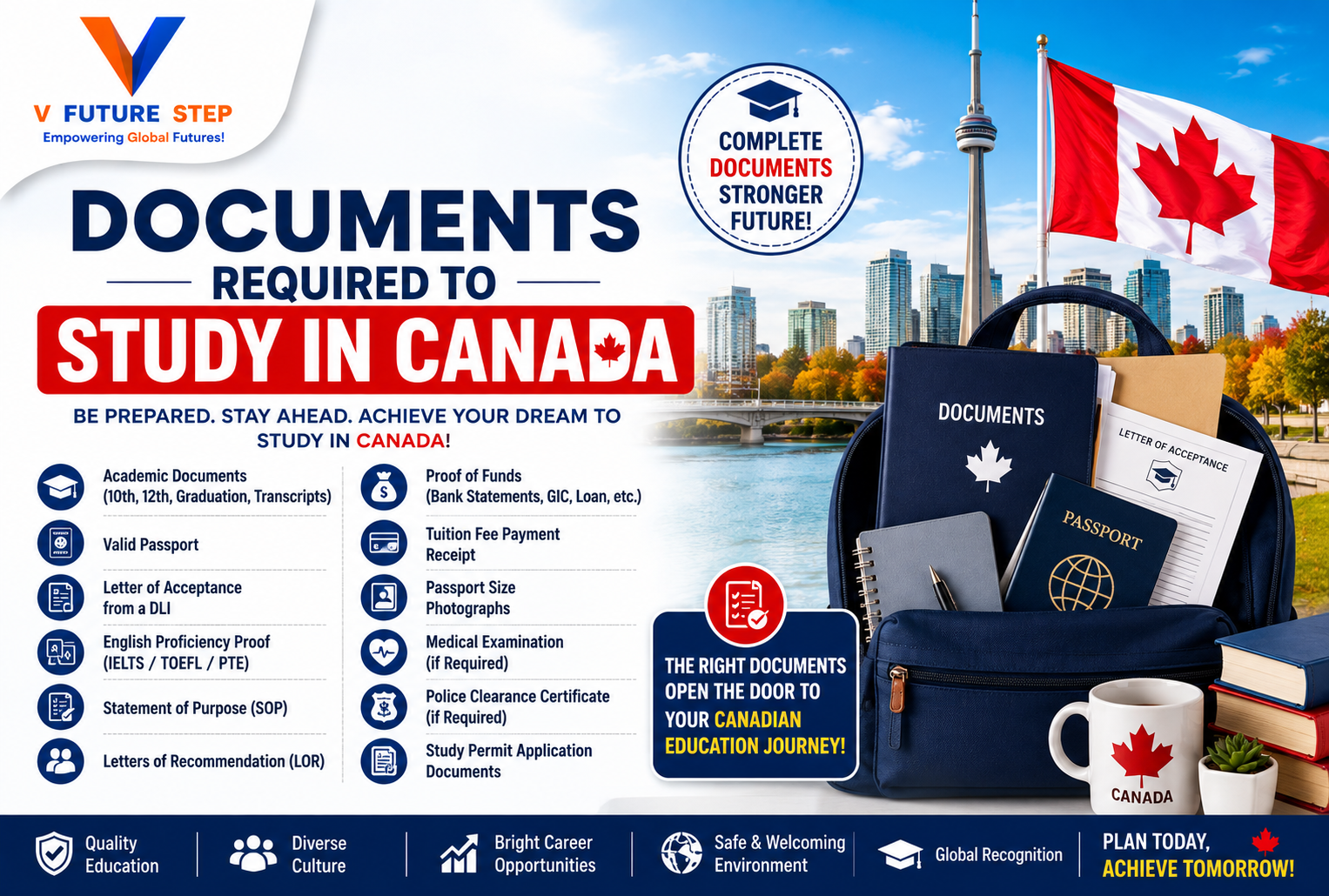
Understanding the Documents Required to Study in Canada helps students prepare well in advance and avoid last-minute stress. Every year, thousands of Indian students choose to study in Canada because of its world-class universities, practical learning approach, multicultural environment, and excellent career opportunities. However, before beginning this journey, students must organize all required academic, financial, and personal documents.
This comprehensive guide explains the Documents Required to Study in Canada, why each document is important, how to prepare them correctly, and common mistakes students should avoid during the admission process.
Why Are Documents Important for Studying in Canada?
Preparing the correct documents is one of the first steps toward securing admission to a Canadian college or university. Educational institutions and immigration authorities use these documents to verify your academic qualifications, identity, financial capability, and eligibility for higher education.
Having complete and organized documentation not only speeds up the admission process but also increases your confidence while applying.
Benefits of Preparing Documents Early
Students who organize their paperwork early can:
- Avoid unnecessary delays.
- Correct missing information.
- Meet application deadlines.
- Improve application accuracy.
- Reduce last-minute stress.
- Prepare for visa processing.
- Plan finances effectively.
- Track application progress with ease.
Students planning to study in Canada should ideally begin collecting documents several months before applying.
Academic Documents Required for Admission
Academic records are among the most important documents requested by Canadian institutions. These documents demonstrate your educational background and help universities assess your eligibility for a particular program.
The Documents Required to Study in Canada vary slightly depending on the course and institution, but academic records are required for almost every application.
Educational Certificates
Students should keep copies of:
- Class 10 mark sheet and certificate
- Class 12 mark sheet and certificate
- Diploma certificates (if applicable)
- Bachelor’s degree certificate
- Semester-wise mark sheets
- Provisional degree certificate (if applicable)
Ensure that all documents are clear, complete, and consistent.
Academic Transcripts
Academic transcripts provide a detailed record of your performance throughout your education.
Universities carefully review transcripts to evaluate your academic consistency, subject knowledge, and overall eligibility.
Why Transcripts Matter
They help institutions understand:
- Subject-wise performance
- Academic progression
- Overall grades
- Course completion status
- Educational background
Students should request official transcripts from their educational institution well before application deadlines.
Valid Passport
A passport is one of the most essential identity documents required throughout the admission and visa process.
Students should ensure that their passport remains valid for an adequate period before applying.
Passport Checklist
Verify that:
- The passport is valid.
- Personal details are correct.
- The passport has sufficient blank pages.
- There is no physical damage.
- The expiry date does not interfere with travel plans.
Always keep both digital and printed copies for future reference.
Letter of Acceptance
Once your application is approved, the Canadian institution issues a Letter of Acceptance.
This document confirms that you have received admission to an eligible educational institution.
Students cannot proceed with several later stages of the process without this important document.
Information Included
The letter generally contains:
- Student name
- Program name
- Institution details
- Course duration
- Intake information
- Tuition details
- Student identification information
Students planning to study in Canada should carefully review all information before proceeding further.
Proof of English Language Proficiency
Many Canadian institutions require proof that international students can communicate effectively in English.
Accepted language proficiency requirements depend on the institution and chosen program.
Commonly Accepted Tests
Students may submit results from:
- IELTS
- PTE
- TOEFL
- Duolingo English Test (where accepted)
Always verify the language requirements of your chosen institution before applying.
Statement of Purpose (SOP)
A Statement of Purpose is one of the most influential parts of your application.
It explains your educational background, career goals, reasons for choosing the course, and why you wish to study in Canada.
A well-written SOP allows admission officers to understand your motivation beyond academic scores.
What an SOP Should Include
A strong SOP should explain:
- Academic background
- Career objectives
- Course selection
- Reasons for choosing Canada
- Future plans
- Personal strengths
- Relevant experiences
Write honestly and professionally while keeping the content clear and focused.
Letters of Recommendation
Many postgraduate and professional programs request recommendation letters from teachers, professors, or employers.
These letters provide independent insights into your academic abilities, work ethic, and potential for success.
Good Recommendation Letters Highlight
- Academic performance
- Leadership qualities
- Communication skills
- Problem-solving ability
- Professional attitude
- Teamwork
- Learning potential
Choose recommenders who know your abilities well and can provide detailed feedback.
Resume or Curriculum Vitae
Some Canadian institutions ask applicants to submit a resume, particularly for postgraduate, MBA, or professional programs.
A well-structured resume provides a summary of your educational qualifications, skills, achievements, internships, projects, and work experience.
Include Information Such As
- Educational qualifications
- Technical skills
- Projects
- Internships
- Certifications
- Achievements
- Volunteer activities
- Work experience
Keep the resume concise, organized, and easy to read.
Financial Documents
Canadian institutions and immigration authorities require evidence that students can financially support their education and living expenses.
Financial documents demonstrate your ability to complete your studies without unexpected financial difficulties.
The Documents Required to Study in Canada include financial evidence that accurately reflects your funding arrangements.
Common Financial Documents
Students may need:
- Bank statements
- Education loan approval (if applicable)
- Scholarship letters
- Sponsor documents
- Income proof
- Financial declarations
- Investment statements (if applicable)
Always ensure that financial information is accurate and consistent.
Passport-Sized Photographs
Students should keep recent passport-sized photographs ready according to the specifications requested during admission and visa applications.
Using incorrect photo specifications may result in delays.
Photograph Guidelines
Photos should generally be:
- Recent
- Clear
- High quality
- Properly sized
- Professionally taken
- Matching official requirements
Store both printed and digital copies for convenience.
Identity and Supporting Documents
Apart from academic records, institutions may request additional identification documents during various stages of the admission process.
Keeping these documents organized helps simplify future requirements.
Additional Documents
Students may prepare:
- National identity documents (where applicable)
- Birth certificate (if required)
- Name change documents (if applicable)
- Marriage certificate (if applicable)
- Medical records (if requested)
Having all supporting documents readily available can prevent unnecessary delays.
Study Permit Documents
After receiving admission from a Canadian institution, students must prepare their study permit application carefully. A complete and accurate application increases the chances of smooth processing.
Students planning to study in Canada should verify every document before submission to avoid unnecessary delays.
The Documents Required to Study in Canada for a study permit must match the information provided during the admission process.
Common Study Permit Documents
Students generally require:
- Valid passport
- Letter of Acceptance
- Completed study permit application
- Passport-sized photographs
- Financial proof
- Academic documents
- Statement of Purpose (if applicable)
- Supporting identity documents
Always ensure that the information across all documents is consistent.
Medical Examination Documents
Depending on individual circumstances and immigration requirements, some students may need to complete a medical examination.
Medical reports help confirm that applicants meet the health requirements applicable to international students.
Medical Document Checklist
Students may need:
- Medical examination confirmation
- Medical reports
- Identification documents
- Appointment confirmation
- Physician-issued certificates (if applicable)
Complete the examination only through approved medical professionals when required.
Police Clearance Certificate (If Required)
Certain applicants may be asked to provide a Police Clearance Certificate during the immigration process.
This document confirms that the applicant has no serious criminal record that would affect their eligibility.
Important Tips
Students should:
- Apply early if required.
- Ensure details match passport information.
- Keep original and photocopies.
- Check validity before submission.
Not every student is required to submit this document, but it is helpful to know the process in advance.
Proof of Financial Support
Financial capability is an important part of the admission and immigration process. Authorities want to ensure that students can manage tuition fees and living expenses while pursuing higher education.
Students planning to study in Canada should organize their financial documents carefully and ensure they are up to date.
Acceptable Financial Evidence
Students may submit:
- Recent bank statements
- Education loan sanction letter
- Scholarship award letter
- Sponsor’s financial documents
- Income proof
- Fixed deposit statements (if applicable)
- Investment documents (where accepted)
The financial information should clearly support your planned education expenses.
Tuition Fee Payment Records
Many institutions request proof that the required tuition fees or deposits have been paid.
Payment receipts also become useful during later stages of the admission and visa process.
Keep Copies Of
- Tuition payment receipts
- Admission fee receipts
- Deposit confirmation
- Payment acknowledgment
- Transaction records
Maintain both printed and digital copies for easy access.
Accommodation Documents
Although accommodation documents may not always be mandatory during admission, they are useful when preparing for travel and settling in Canada.
Planning accommodation early also makes the transition much easier.
Useful Accommodation Documents
Students should keep:
- Hostel confirmation
- Rental agreement
- Temporary accommodation booking
- Contact information
- Address details
These documents can also assist during your arrival in Canada.
Organizing Your Documents
Proper organization makes the admission and visa process much more efficient. Instead of searching for documents at the last minute, students should prepare both physical and digital copies.
The Documents Required to Study in Canada should always be arranged in a logical order so they are easy to locate whenever needed.
Recommended Organization Method
Create separate folders for:
- Academic documents
- Identity documents
- Financial documents
- Admission documents
- Visa documents
- Travel documents
- Medical records
- Accommodation documents
Maintaining organized files saves time throughout the application process.
Common Mistakes Students Should Avoid
Many application delays occur because students overlook small but important details.
Avoiding these common mistakes improves the overall quality of your application.
Mistakes to Avoid
Do not:
- Submit incomplete applications.
- Upload unclear document scans.
- Use expired documents.
- Miss application deadlines.
- Ignore document instructions.
- Submit inconsistent information.
- Forget to sign required forms.
- Delay document preparation.
Double-checking every document before submission can prevent unnecessary complications.
Tips for a Smooth Documentation Process
Preparing documents in advance reduces stress and allows sufficient time to correct any errors.
Students should begin collecting their paperwork several months before applying.
Helpful Tips
Students should:
- Create a document checklist.
- Keep multiple photocopies.
- Save digital backups securely.
- Verify document validity.
- Organize documents by category.
- Review application requirements regularly.
- Monitor important deadlines.
- Keep all receipts safely.
These simple habits make the application process much easier.
Final Thoughts
Preparing the Documents Required to Study in Canada is one of the most important steps in your international education journey. Complete and accurate documentation not only strengthens your admission application but also helps ensure a smoother study permit process.
Students planning to study in Canada should begin preparing their paperwork well in advance, carefully review every document, and maintain organized records throughout the admission process. From academic transcripts and financial proof to passports and admission letters, every document plays an important role in demonstrating your eligibility and readiness for higher education.
By understanding the Documents Required to Study in Canada, planning ahead, and avoiding common mistakes, students can confidently move one step closer to achieving their dream of an international education.
Frequently Asked Questions
What are the most important documents required to study in Canada?
The most important documents include your passport, academic transcripts, Letter of Acceptance, proof of financial support, English language proficiency results, Statement of Purpose, and study permit application documents.
When should I start preparing my documents?
It is advisable to begin preparing your documents several months before your intended intake to avoid delays and ensure all paperwork is complete.
Do all Canadian institutions require the same documents?
Most institutions require similar core documents, but additional requirements may vary depending on the university, program, and level of study.
Can incomplete documents delay my application?
Yes. Missing, incorrect, or inconsistent documents can delay both admission and study permit processing.
Why is financial proof important?
Financial documents demonstrate that you have sufficient resources to pay tuition fees and support yourself while you study in Canada.
Why Choose V Future Step?
At V Future Step, we help students explore, compare, and choose the right study abroad options based on their academic profile, career aspirations, and budget. Our expert guidance makes the admission process simple, transparent, and stress-free.
We also connect students with the right-fit agencies and provide complete support with university selection, applications, documentation, financial planning, and visa guidance. Whether your goal is to study in Canada or another leading destination, V Future Step is committed to helping you build a successful international future.