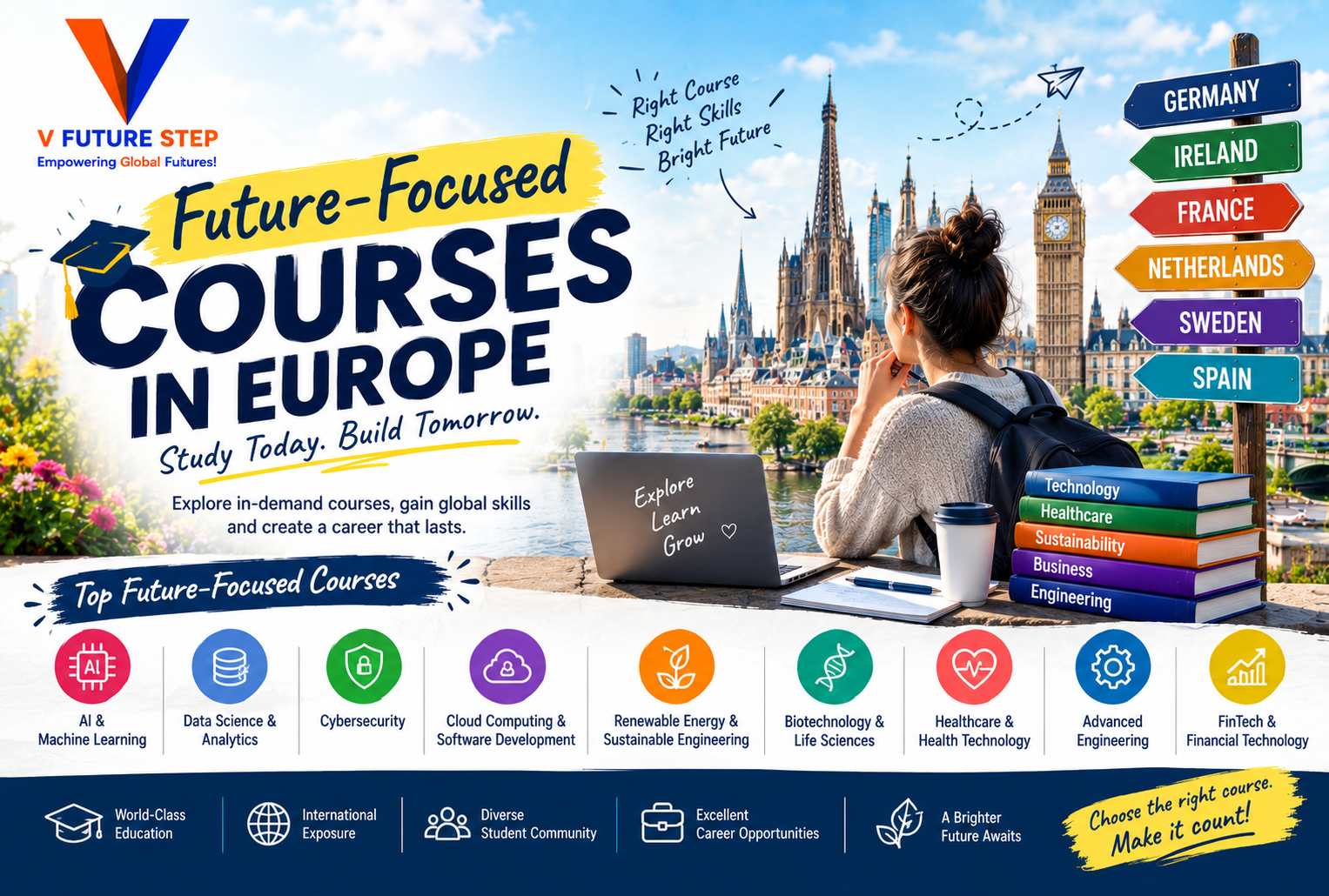
Choosing a course is one of the biggest decisions students make before they study in Europe. However, the best course is not always the most popular one today. Instead, students should look at the skills that may remain valuable as technology, healthcare, engineering, business, and sustainability continue to evolve.
That is why Future-Focused Courses in Europe deserve attention. These programs can help students build practical knowledge while preparing for changing industries. Moreover, Europe offers a wide range of academic environments, from technology-focused universities to institutions known for engineering, research, business, and sustainability.
What Makes a Course Future-Focused?
A future-focused course should teach more than information that may become outdated quickly. Instead, it should help students develop skills that can be applied in different situations.
For example, analytical thinking, digital skills, problem-solving, communication, research, and project management can support many career paths. In addition, practical learning can help students understand how their knowledge works outside the classroom.
Therefore, do not judge a course only by its title. First, review the modules. Next, check practical projects, tools, internships, and industry exposure. Finally, consider whether the skills match your long-term goals.
Artificial Intelligence and Machine Learning
Artificial intelligence has become an important area across many industries. Therefore, AI and machine learning programs can be attractive to students who enjoy technology, mathematics, logic, and problem-solving.
These courses can cover areas such as machine learning, data analysis, automation, programming, and intelligent systems. Moreover, AI knowledge can connect with industries beyond traditional software development.
For example, AI skills can be useful in finance, healthcare, manufacturing, marketing, logistics, and research. As a result, students can develop a flexible technical foundation.
However, students should also consider mathematics, programming, and analytical requirements before applying.
Data Science and Business Analytics
Data is now important in many types of organisations. Therefore, data science and business analytics are worth considering when students compare Future-Focused Courses in Europe.
Data-focused programs can teach students how to collect, organise, analyse, and interpret information. In addition, many courses include statistics, visualisation, databases, programming, and business decision-making.
For example, a data graduate may work with business teams, technology teams, finance departments, or research groups. Similarly, business analytics can help students combine technical and business knowledge.
Therefore, these courses can suit students who enjoy both numbers and practical decision-making.
Cybersecurity
As organisations depend more on digital systems, cybersecurity has become an important field. Therefore, students interested in technology and security can consider cybersecurity programs.
These courses may cover network security, ethical security practices, digital systems, risk management, and security analysis. Moreover, students may gain practical experience through labs and security projects.
However, cybersecurity requires continuous learning. New technologies and threats can change quickly. Therefore, students should choose programs that focus on strong fundamentals as well as current tools.
Cloud Computing and Software Development
Cloud technology supports many modern digital services. Therefore, cloud computing can be another strong course area for students who want technical careers.
Students may learn about cloud architecture, databases, networks, software systems, and deployment. In addition, many programs combine cloud knowledge with programming and system administration.
Similarly, software development remains useful because businesses continue to build digital products and services.
Therefore, students who want to study in Europe can compare software, cloud, and related technology programs based on their interests and technical strengths.
Renewable Energy and Sustainable Engineering
Technology is not the only area shaping the future. Sustainability is also becoming an important part of business, infrastructure, transportation, and energy planning.
Therefore, renewable energy and sustainable engineering programs deserve attention. Students may explore solar energy, wind systems, energy efficiency, environmental technology, and sustainable infrastructure.
Moreover, engineering skills can transfer across different projects and industries. As a result, students can build a technical foundation while working toward careers connected with sustainability.
Environmental Science and Sustainability
Students who prefer environmental subjects can consider sustainability-related programs. These courses can combine science, policy, resource management, environmental planning, and sustainable development.
For example, students may explore climate-related challenges, environmental management, waste reduction, or sustainable business practices.
In addition, sustainability is not limited to one industry. Businesses, governments, manufacturers, and communities all need people who understand environmental challenges.
Therefore, this field can suit students who want to combine science with broader social and economic goals.
Biotechnology and Life Sciences
Healthcare and scientific research continue to create opportunities for students with strong science backgrounds. Therefore, biotechnology and life sciences can be valuable options.
Programs may include molecular biology, genetics, laboratory methods, biomedical science, or related subjects. Moreover, some courses provide strong research components.
However, these programs can be academically demanding. Therefore, students should check subject requirements before applying.
Healthcare and Health Technology
Healthcare is changing alongside digital technology. Therefore, students interested in medicine, health systems, technology, or patient support can explore health-related programs.
For example, health informatics combines healthcare knowledge with data and information systems. Similarly, public health programs can develop skills related to health planning and population-level challenges.
In addition, digital tools are becoming more important in modern healthcare environments. As a result, students may benefit from programs that combine health knowledge with technology.
Advanced Engineering
Engineering remains a broad field with applications across transportation, manufacturing, energy, construction, electronics, and technology.
Therefore, students should look beyond general engineering titles and compare specialisations. For example, electronics, automation, robotics, mechanical systems, and industrial engineering can offer different skill paths.
Moreover, interdisciplinary programs can be particularly useful. A course that combines engineering with software, automation, or data can provide a wider skill set.
FinTech and Financial Technology
Finance is also being transformed by technology. Therefore, FinTech can interest students who enjoy business, finance, technology, and analysis.
Programs may combine financial concepts with data, digital systems, programming, payments, or financial innovation. In addition, students can develop an understanding of how technology changes financial services.
For example, the course may suit students interested in digital banking, financial data, technology-driven services, or business innovation.
How to Shortlist the Right Course
The number of options can feel overwhelming. However, a simple process can make selection easier.
First, identify the subjects you enjoy. Next, consider your academic strengths. Then, research the skills required for careers you may want.
After that, compare course modules, practical learning, internships, duration, tuition, and location.
Finally, review whether the program fits your financial plan and future expectations.
This process is particularly useful when you study in Europe, because different countries and institutions may offer different versions of similar programs.
Do Not Choose a Trend Alone
A course can become popular very quickly. However, popularity does not guarantee that it is right for you.
Therefore, focus on the skills behind the trend. For example, instead of choosing a program only because it includes the word “AI,” examine what you will actually learn.
Similarly, do not choose a sustainability course without checking its scientific or technical content.
As a result, thoughtful comparison can help you avoid making a decision based purely on marketing.
Build Skills Alongside Your Degree
A strong degree is useful, but additional skills can make your profile stronger. Therefore, consider certifications, projects, internships, competitions, portfolios, and practical experience alongside your studies.
For example, a data student can develop projects using real datasets. Similarly, a software student can build applications to demonstrate technical ability.
Moreover, communication and teamwork should not be ignored. Employers often value people who can explain ideas clearly and work effectively with others.
Therefore, Future-Focused Courses in Europe should be viewed as a foundation for continuous learning rather than a final destination.
How to Choose Future-Focused Courses in Europe
Choosing Future-Focused Courses in Europe requires more than finding a subject that sounds modern. Instead, you need to understand the course structure, your own strengths, and the career direction you want to follow.
First, review the academic requirements. Next, compare the curriculum. Then, examine practical learning, costs, internships, and career support.
Most importantly, choose a program that you can realistically complete and enjoy.
Look for Practical Learning
Theory provides an academic foundation. However, practical learning can help you apply that knowledge.
Therefore, check whether your shortlisted course includes projects, laboratories, simulations, case studies, workshops, or internships.
For example, cybersecurity students may benefit from security labs. Similarly, engineering students can gain useful experience through practical projects.
Meanwhile, business analytics students can learn more effectively when they work with data and real business problems.
As a result, practical learning can help connect classroom knowledge with professional expectations.
Consider Interdisciplinary Programs
Modern careers do not always fit into one academic category. Therefore, interdisciplinary courses can be attractive.
For example, data science can connect technology with business. Health informatics can combine healthcare with information systems. Similarly, sustainable engineering can connect engineering with environmental goals.
Moreover, interdisciplinary learning can help students understand problems from more than one perspective.
Therefore, when you study in Europe, do not limit yourself to traditional course categories. Look for programs that combine complementary skills.
Compare Course Duration
Course duration can affect both your academic timeline and total spending. Therefore, compare the length of similar programs before making a decision.
For example, two master’s programs may cover related subjects but have different structures. One may focus more on theory, while another may include projects or industry experience.
However, shorter does not automatically mean better. Likewise, a longer program is not automatically more valuable.
Instead, ask whether the additional study time provides skills or experience that support your goals.
Think About Career Flexibility
A future-focused course should ideally prepare you for more than one possible role. Therefore, check whether the skills you learn can transfer across industries.
For example, data analysis can be useful in technology, finance, healthcare, retail, and business. Similarly, project management can support different technical and non-technical roles.
In addition, communication, research, and problem-solving can remain useful even when specific technologies change.
As a result, transferable skills can make your qualification more adaptable.
Review Industry Exposure
Industry exposure can strengthen the learning experience. Therefore, look for universities that offer projects, company interactions, career events, internships, or practical assignments.
For example, a technology student may benefit from working on software or data projects. Similarly, an engineering student may value industry-based design work.
However, do not assume that every university offers the same level of exposure. Instead, compare the exact program.
Consider the Cost and Return
Affordability should always be part of your decision. Therefore, calculate tuition and living expenses before accepting an offer.
First, estimate tuition. Next, add accommodation, food, transportation, insurance, and other regular costs.
Then, compare those expenses with the value of the course. For example, a program with strong practical learning may offer more value than one with similar tuition but fewer opportunities.
Moreover, scholarships can sometimes reduce the financial burden. Therefore, research financial support while comparing programs.
Think About the Country After Choosing the Course
Students often choose a country first. However, the course should usually come before the destination.
For example, a student interested in renewable energy may compare several European countries. Similarly, an AI student can explore different universities offering strong technical programs.
Therefore, start with your subject, then compare destinations.
Students planning to study in Europe can benefit from this approach because it creates a wider and more meaningful shortlist.
Compare Language Requirements
Language can influence your study experience. Therefore, check whether the course is taught in English or another language and understand the requirements before applying.
For example, some programs may be fully taught in English, while others may include local-language components.
In addition, consider your communication comfort outside the classroom.
As a result, language planning can help you adapt more easily to academic and everyday life.
Check Your Academic Fit
A course may sound exciting, but that does not mean it will suit your background. Therefore, review the required subjects and qualifications carefully.
For example, some technical programs may expect mathematics or programming knowledge. Similarly, science-based courses may require relevant previous subjects.
However, do not reject a program without checking the complete admission requirements.
Instead, identify any skill gaps and decide whether you can prepare for them before enrolment.
Consider Europe’s Different Study Environments
Europe is not one single academic environment. Therefore, compare countries and institutions individually.
For example, some universities may focus heavily on research, while others may provide more applied learning. Similarly, some cities may offer stronger connections with particular industries.
Moreover, living costs and student lifestyles can vary widely.
Therefore, students should compare the complete experience rather than assuming every European destination is the same.
Courses Worth Watching
Several subject areas can be especially interesting for students thinking about their future.
AI and machine learning can suit students interested in intelligent technologies. Data science can suit analytical learners. Cybersecurity can appeal to students interested in digital protection.
Similarly, renewable energy, sustainable engineering, biotechnology, health technology, cloud computing, software development, advanced engineering, and FinTech can provide different paths.
However, the best choice depends on your background and interests.
Create a Personal Course Checklist
Before making your final decision, ask yourself a few practical questions.
Does the course match my academic background? Does it teach useful skills? Is the curriculum practical? Can I afford the complete cost? Does it support my career direction? Will I enjoy studying these subjects?
Next, compare your top choices using the same questions.
As a result, you can make your final decision with greater confidence.
Avoid These Common Mistakes
One mistake is choosing a course only because it has a modern name. Another is selecting a program because friends are applying.
Similarly, some students focus only on university rankings. However, rankings do not tell you everything about curriculum, practical learning, or personal suitability.
Finally, do not assume that a future-focused course guarantees employment.
Therefore, focus on building relevant skills, gaining experience, and developing a strong academic foundation.
Keep Learning After Graduation
Technology and industries will continue to change. Therefore, your degree should be viewed as the beginning of your professional learning journey.
First, build strong fundamentals. Next, gain practical experience. Then, continue updating your skills.
For example, a technology graduate may learn new tools over time. Similarly, a sustainability professional may need to understand new technologies and regulations.
Moreover, communication and problem-solving skills can continue to support your career.
Final Thoughts
Choosing the right course can be more important than choosing a destination based only on popularity. Therefore, students should look closely at the knowledge, skills, practical experience, and career flexibility offered by each program.
When you study in Europe, take time to compare courses instead of selecting the first attractive option. Consider your interests, academic background, budget, location, and future goals together.
Ultimately, the strongest Future-Focused Courses in Europe are not simply the courses with the newest names. They are programs that help students build useful skills, adapt to change, and move confidently toward their chosen careers.
How V Future Step Can Help
Choosing a future-focused course can feel difficult when there are many countries, universities, and programs to compare. Therefore, the right guidance can help you make a more informed decision.
V Future Step helps students explore, compare, and choose the right study abroad options based on their interests, academic profile, budget, and future goals. In addition, V Future Step connects students with right-fit agencies and guidance for course selection, applications, documentation, and visa planning.
FAQs
Which courses are considered future-focused in Europe?
AI, data science, cybersecurity, cloud computing, software development, renewable energy, sustainable engineering, biotechnology, health technology, advanced engineering, and FinTech are examples worth researching.
Should I choose a course based on current job trends?
Not alone. Instead, focus on strong fundamentals, transferable skills, practical learning, and your own interests.
Are future-focused courses suitable for every student?
No. Each student has different strengths and academic backgrounds. Therefore, check admission requirements and course content carefully.
Can I combine technology with another field?
Yes. Interdisciplinary programs can combine areas such as technology and business, healthcare and data, or engineering and sustainability. However, review the actual curriculum before applying.
Should I compare different European countries?
Yes. Tuition, living costs, course structures, language requirements, and student environments can vary. Therefore, compare countries after identifying suitable programs.
Is study in Europe a good choice for future-focused education?
It can be a strong option for students who carefully compare programs, institutions, costs, and career goals. The right course should always be the centre of the decision.