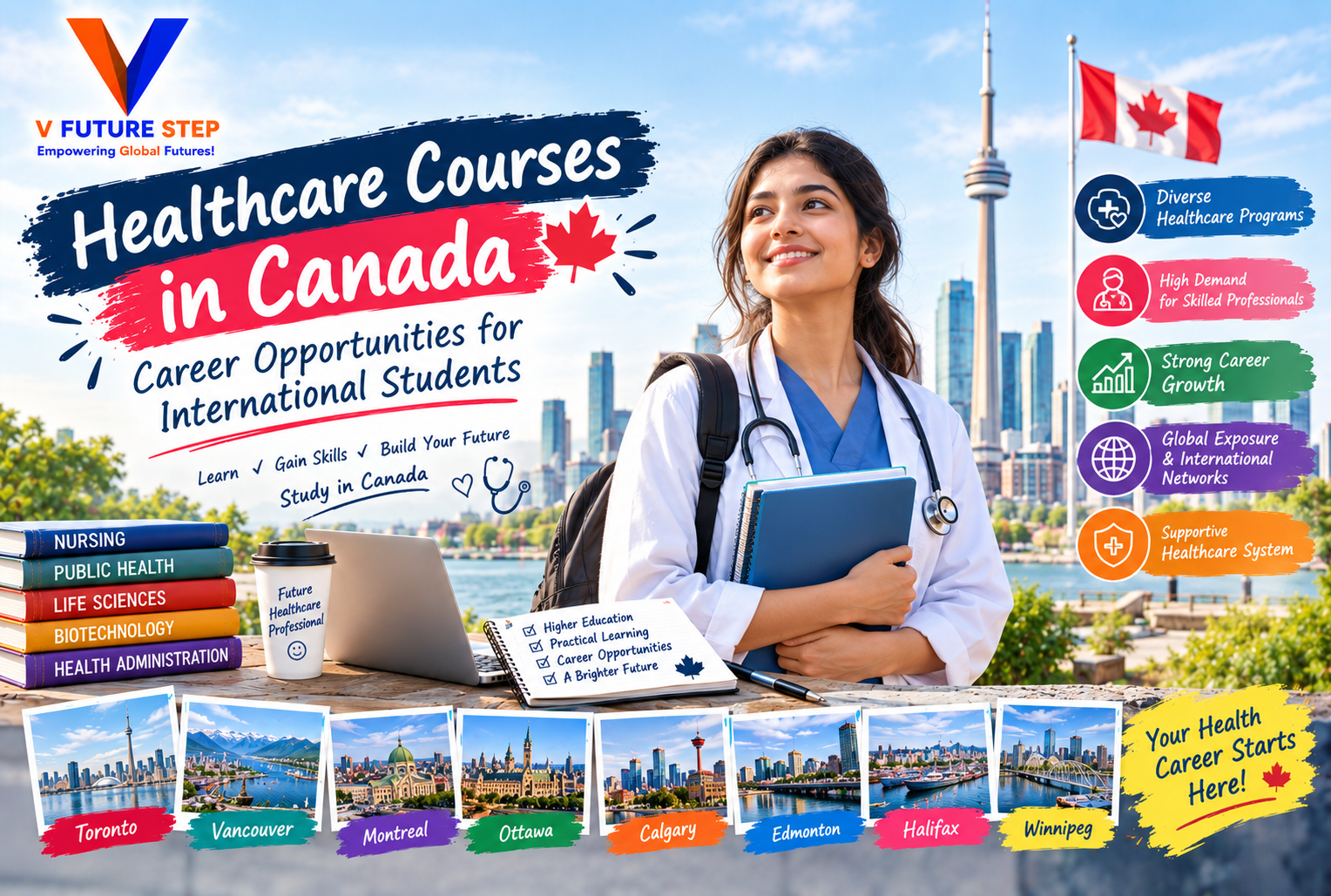
Healthcare is one of the most important areas of modern society. Therefore, students who enjoy science, technology, research, or helping people may consider healthcare as a future field. For international students, Healthcare Courses in Canada can provide different academic pathways, from health sciences and public health to laboratory studies and healthcare technology.
Canada offers health and life sciences programs across universities and colleges. These programs can include scientific foundations, practical learning, research, data analysis, and other skills.
However, choosing a healthcare program should involve more than looking at the course title. Students should consider their previous education, career interests, academic strengths, budget, and future plans. Therefore, students planning to study in Canada should research the complete pathway before selecting a program.
Why Healthcare Is a Broad Study Area
Healthcare is much broader than becoming a doctor or nurse. In fact, the sector includes many different professional and technical areas.
For example, students can explore laboratory technology, public health, health sciences, pharmacy-related studies, rehabilitation, medical support, healthcare administration, and health data.
Moreover, health and life sciences can connect with biotechnology, research, diagnostics, and technology. Therefore, students with different academic backgrounds may find suitable pathways.
Health Sciences and Life Sciences
Health sciences can introduce students to human health, biology, disease prevention, healthcare systems, and related subjects.
Similarly, life sciences can focus on living systems and scientific research. Students may learn about biology, disease processes, diagnostics, and evidence-based decision-making.
In addition, these areas can lead toward research, laboratory, biotechnology, public health, and analytical roles. Canada’s official study information highlights laboratory, research, biotechnology, and health-data pathways within the wider health and life sciences sector.
Therefore, students who enjoy science but do not want a purely clinical career can consider these options.
Nursing and Patient-Care Pathways
Nursing is another important area of healthcare education. However, students should understand that professional healthcare roles can have specific education, licensing, registration, and practice requirements.
Therefore, simply completing a related course does not automatically mean that a student can practise in a regulated profession.
International students should check the exact requirements connected with the profession and province they are considering.
This is especially important because healthcare regulation in Canada involves provincial and territorial systems.
Laboratory and Diagnostic Studies
Students interested in science and testing can explore laboratory-related programs.
For example, laboratory education can prepare students for work connected with medical testing, sample analysis, diagnostics, research, and quality processes.
Moreover, Canada has health education accreditation covering areas such as medical laboratory technology, diagnostic cytology, nuclear medicine, radiological technology, and other healthcare programs.
Therefore, students who prefer laboratory environments may find this pathway more suitable than direct patient-care roles.
Pharmacy-Related Education
Pharmacy is another healthcare area that combines science with patient-focused services.
Students interested in medicines, pharmaceutical science, pharmacy technology, or related areas can research different educational pathways.
However, students should distinguish between studying a pharmacy-related subject and becoming a licensed pharmacist.
Therefore, check the professional requirements before making a decision.
Public Health
Public health focuses on health at a community and population level rather than only individual patient care.
For example, students may study disease prevention, health promotion, health policy, epidemiology, community health, and health systems.
Moreover, public health can connect with research, government, non-profit organisations, healthcare planning, and data analysis.
Therefore, this field may suit students who want to improve health outcomes on a broader scale.
Healthcare and Technology
Healthcare is increasingly connected with technology. Therefore, students who enjoy both healthcare and technology can explore areas such as health information, medical data, digital health, and healthcare analytics.
For example, health-data professionals can use information to support research, healthcare planning, decision-making, and system improvement.
As a result, students with an interest in technology do not necessarily have to choose between technology and healthcare.
Rehabilitation and Therapeutic Fields
Healthcare also includes rehabilitation and therapeutic professions.
These areas can involve helping people improve physical function, manage conditions, or maintain independence.
However, each professional pathway can have its own educational and regulatory requirements. Therefore, students should investigate the exact qualification needed for their intended role.
Current Canadian program information includes fields such as occupational therapy, rehabilitation, therapeutic professions, and related areas.
Healthcare Administration
Not every healthcare career involves direct patient care.
Healthcare organisations also need people who understand management, administration, planning, operations, and healthcare systems.
Therefore, students who enjoy business and healthcare can explore healthcare administration or health management pathways.
For example, these areas may connect with hospitals, clinics, health organisations, and other healthcare services.
Why Practical Learning Matters
Healthcare education can benefit from practical learning because students need to understand how knowledge is applied.
Therefore, when comparing Healthcare Courses in Canada, look at laboratories, research opportunities, projects, simulations, placements, and other practical components where applicable.
For example, health and life sciences programs may provide access to laboratories, clinical settings, research facilities, and partnerships with healthcare or research organisations.
As a result, practical learning can help students connect classroom knowledge with real-world situations.
Choosing a Course Based on Your Background
Your previous education should influence your choice.
For example, a biology student may naturally explore health sciences or life sciences. Similarly, a student with a technology background may consider health data or digital health.
Meanwhile, a student with a business background may explore healthcare management.
Therefore, do not choose a program simply because healthcare sounds popular.
Instead, ask whether your existing skills and interests fit the course.
Career Opportunities Beyond Hospitals
Many students associate healthcare only with hospitals. However, the sector is much broader.
Healthcare and life sciences professionals can work in laboratories, research centres, biotechnology companies, public health organisations, healthcare organisations, and other settings.
Therefore, students can explore careers connected with research, diagnostics, health data, biotechnology, administration, and healthcare services.
Think About Your Career Goal Early
Before you apply, identify the type of work you would enjoy.
Do you prefer working with people? Or do you prefer research and laboratory work? Would you enjoy data and technology? Are you interested in public health or healthcare management?
Therefore, your answers can help narrow your options.
When students study in Canada, they should ideally choose a program that connects their academic interests with a realistic career direction.
Do Not Choose Only Because Healthcare Is in Demand
Healthcare is an important sector, and Canada continues to address health workforce challenges. However, demand alone should not determine your course choice. Canada’s health workforce includes doctors, nurses, allied health professionals, diagnostic providers, and many other workers.
Therefore, choose a field that matches your abilities and interests.
A course may have strong career potential, but it still requires commitment, academic effort, and professional preparation.
Check Program Requirements Carefully
Every program can have different admission requirements. Therefore, check academic prerequisites, language requirements, previous subjects, and any practical requirements before applying.
In addition, check whether the qualification leads directly to the career you want or whether additional certification or registration is required.
As a result, you can avoid choosing a course that does not match your long-term plan.
What Comes Next
Healthcare offers many possibilities, but the right pathway depends on the individual student.
Therefore, students should compare courses, institutions, costs, practical learning, professional requirements, and career outcomes.
Building a Career After Healthcare Studies
The value of Healthcare Courses in Canada depends not only on the classroom experience but also on how students use their education afterward.
Therefore, career planning should begin before graduation. Students can explore relevant skills, practical experience, professional requirements, and potential work environments throughout their studies.
Explore Different Career Directions
Healthcare education can lead toward several types of careers.
For example, students may explore laboratory work, health research, public health, biotechnology, health data, healthcare administration, or patient-support roles.
Moreover, some pathways can combine healthcare with technology, business, or scientific research.
Therefore, students should look beyond a single job title.
Healthcare Research Opportunities
Research is an important part of health and life sciences.
Students who enjoy investigation can explore research projects related to disease, diagnostics, health systems, biotechnology, or public health.
In addition, research skills can support careers in universities, research centres, biotechnology companies, and other organisations.
Therefore, students who prefer scientific work should investigate programs with research components.
Healthcare Data and Analytics
Healthcare increasingly uses data to improve planning and decision-making.
For example, health-data professionals can analyse information related to healthcare systems, research, patient outcomes, and service efficiency.
Therefore, students who enjoy statistics, technology, and healthcare can explore this combination.
Moreover, this pathway shows why healthcare education is no longer limited to traditional clinical roles.
Biotechnology and Pharmaceutical Careers
Biotechnology combines biological science with innovation. Similarly, pharmaceutical fields connect science with medicines, research, production, and healthcare.
Therefore, students interested in laboratory science and innovation can explore these areas.
However, career requirements can vary between roles. As a result, students should check the exact qualifications required for their target position.
Understand Licensing Requirements
This is one of the most important points for international students.
Some healthcare professions are regulated. Therefore, completing an academic program may not be enough to practise professionally.
For example, regulated professions can require registration, examinations, supervised practice, or other provincial requirements.
Canada also notes that internationally educated health professionals can face complex credential-recognition processes.
Therefore, check professional requirements before choosing your course.
Check the Province Before Choosing
Healthcare regulation can differ across provinces and territories. Therefore, students should not assume that one pathway works exactly the same everywhere.
For example, a student planning to enter a regulated profession should research the relevant provincial regulator and registration pathway.
Moreover, the institution and program should be checked against those requirements.
As a result, students can make decisions with fewer surprises later.
Consider Career-Focused Skills
A healthcare degree should develop useful skills alongside subject knowledge.
For example, students can strengthen communication, research, teamwork, problem-solving, data interpretation, and professional writing.
In addition, digital skills can become valuable in modern healthcare environments.
Therefore, students should look for opportunities to develop these abilities throughout the program.
Practical Experience Can Add Value
Academic knowledge is important. However, practical exposure can help students understand how healthcare environments operate.
Therefore, consider programs that offer relevant practical components where appropriate.
For example, laboratory programs may include hands-on laboratory learning. Similarly, other health programs may provide projects, simulations, research, or placements depending on their structure.
As a result, students can better understand how their knowledge connects with professional environments.
Plan Your Budget
Healthcare education can involve tuition and additional academic expenses. Therefore, create a complete budget before applying.
First, calculate tuition. Next, estimate accommodation and food. Then, include transportation, study materials, insurance, personal expenses, and emergency savings.
Moreover, practical courses may have additional requirements.
Therefore, confirm costs with the institution before making your final financial plan. EduCanada notes that tuition and program information can change and recommends confirming details with the institution.
Think About Your City Too
Your course and university are important. However, your city can also affect your student experience.
For example, accommodation costs, transportation, healthcare-related employers, and student communities can vary by location.
Therefore, compare cities as well as programs.
When you study in Canada, choosing a suitable location can make daily life easier and help you focus on your education.
Understand Work and Post-Graduation Rules
International students should also understand the rules connected with studying and working in Canada.
For example, eligibility for post-graduation work options can depend on program details and other requirements. Canada’s current guidance includes healthcare and social-services fields among eligible areas under the applicable field-of-study rules, but eligibility can depend on the specific program and application circumstances.
Therefore, students should check the current requirements rather than assuming that every healthcare course provides the same outcome.
Avoid Choosing a Course for Immigration Reasons Alone
Healthcare can have strong workforce needs in Canada. However, immigration should not be the only reason to choose a healthcare program.
Instead, consider your academic interests and career goals first.
For example, someone who dislikes laboratory work may struggle in a laboratory-focused program. Similarly, someone uncomfortable with patient-facing environments may prefer a research or data pathway.
Therefore, choose a field you can realistically enjoy and complete.
Common Mistakes to Avoid
One common mistake is choosing a course only because it appears popular.
Another is confusing a healthcare-related qualification with a professional licence.
Similarly, some students focus only on tuition and ignore accommodation and other expenses.
Therefore, research the complete pathway.
Another mistake is waiting until graduation to understand professional requirements.
Instead, check them before applying.
A Simple Healthcare Course Checklist
Before choosing a program, ask these questions:
Academic Fit
Does the course match my previous education?
Does it teach subjects that interest me?
Will I enjoy the learning style?
Career Fit
What jobs can this qualification support?
Is the target profession regulated?
Will I need additional registration or certification?
Financial Fit
Can I afford tuition and living costs?
Do I have a realistic emergency budget?
Are there additional course-related expenses?
Practical Fit
Does the program offer relevant projects, research, laboratory work, simulations, or placements?
Therefore, using a checklist can make the decision much clearer.
Why Healthcare Can Be a Flexible Field
Healthcare connects science, technology, research, management, and direct care.
Therefore, students can explore different directions as their interests develop.
For example, a science-focused student may choose laboratory work. A technology-focused student may explore health data. A research-oriented student may enter life sciences or biotechnology.
Meanwhile, a student interested in communities may explore public health.
As a result, healthcare can offer more variety than many students initially expect.
Final Thoughts
Healthcare Courses in Canada can open different academic and career pathways for international students. However, the right course depends on your background, interests, budget, and professional goals.
Therefore, do not choose a program simply because healthcare is considered an important sector.
Instead, compare course content, practical learning, career pathways, professional requirements, costs, location, and future opportunities.
Students who study in Canada should also understand that regulated healthcare careers may require additional registration or credential recognition.
Ultimately, the strongest choice is a healthcare program that fits both your present abilities and your future plans.
How V Future Step Can Help
Choosing between healthcare courses, universities, career pathways, and Canadian destinations can feel complicated. Therefore, students can benefit from structured guidance before making a decision.
V Future Step helps students explore, compare, and choose the right study abroad options based on their academic background, interests, budget, and career goals. In addition, V Future Step connects students with right-fit agencies and guidance for course selection, applications, documentation, and visa planning.
FAQs
What healthcare courses can international students study in Canada?
Options can include health sciences, life sciences, public health, laboratory studies, pharmacy-related programs, rehabilitation, healthcare administration, and health-data pathways. The exact options depend on the institution.
Are healthcare careers in Canada regulated?
Some are. Therefore, students should check the registration and licensing requirements for their intended profession and province.
Is nursing a good option for international students?
Nursing can be a career pathway, but students must carefully check admission, professional registration, and provincial requirements before choosing a program.
Can healthcare students work in research?
Yes. Depending on their education and skills, students can explore research-related pathways in health sciences, biotechnology, laboratories, and public health.
Can healthcare connect with technology?
Yes. Healthcare increasingly uses data and digital tools. Therefore, students interested in both technology and health can explore health-data and related fields.
Should I choose a healthcare course because of job demand?
Demand can be one consideration. However, your interests, abilities, professional requirements, and long-term career goals should also guide the decision.